A combination of heat, improper nutrition/hydration, and cumulative training fatigue lead me to bonk on this one. Big time. For the 30K race I was expecting something in the neighborhood of 3:15. I was fit enough for that time, maybe even faster. But, it took me 3:42, which is is WAY off the pace I had expected. [Note: In the same race in 2011 I finished in 3:01.]
To make matters worse, this was the first race that my parents were ever able to attend. And my wife. And my son. Who all sat out in the heat waiting, and waiting, and waiting for me to stumble through the finish. The first loop was roughly on target, if not a bit too fast at about 59 minutes. Then came 75 minute, then, for the 3rd loop, 90 minutes. Those are 10K loops so you can imagine the sort of pain involved if it took me an entire 30 minutes longer to do the 3rd than the first lap. Major suffer fest. Early into the 3rd lap I started cramping – both hamstrings – and by about 25K I started having real issues, including trouble hearing. Not good. Writing this now (in June 2011), I fully realize that I was dealing with the effects of low electrolytes and possibly severe dehydration. A gel pack with some water every 20 minutes during the race and the whole mess could have been avoided. As it was, I was happy to finish at all, keeping my still-unbroken history of completing every event I’ve entered.
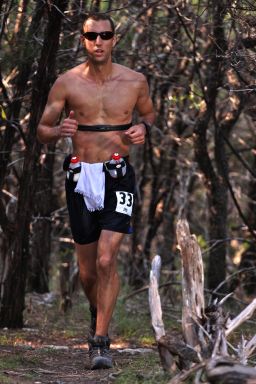
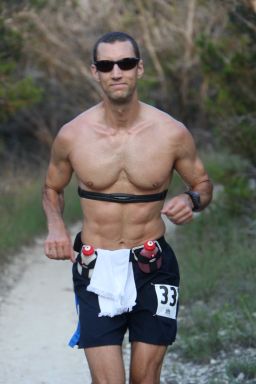
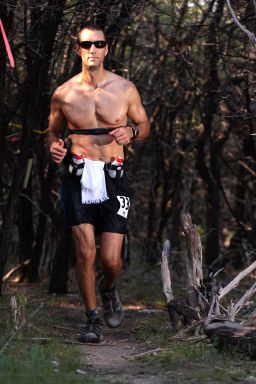
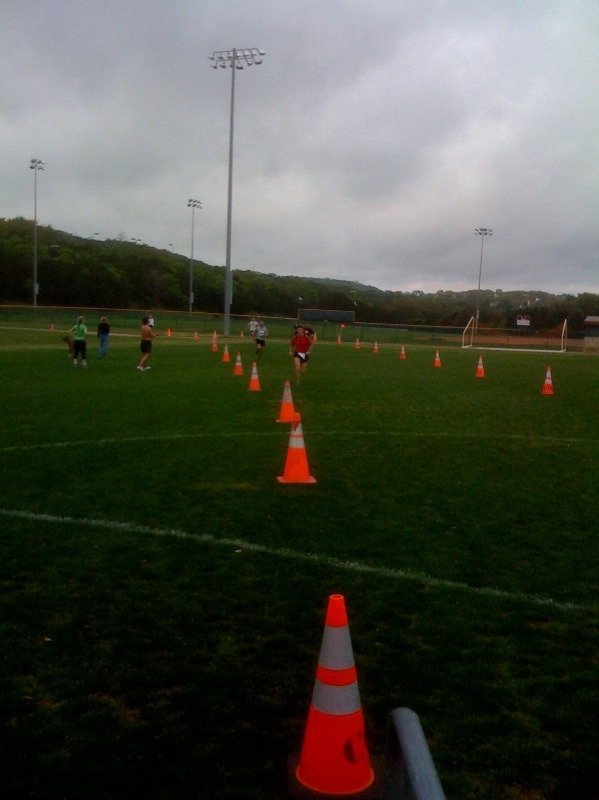
Some pics from the event, I assume before I crashed:
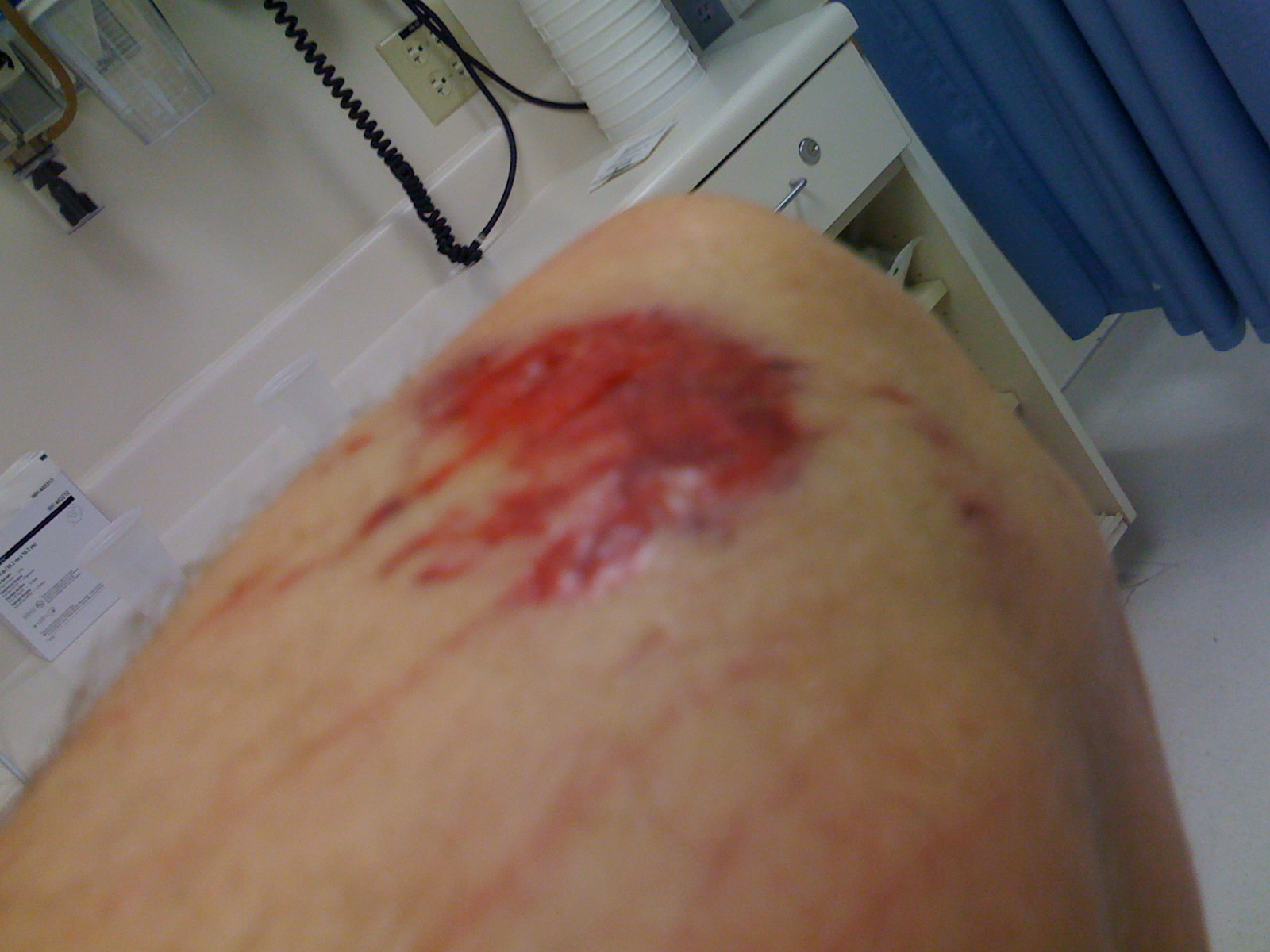
Out on a 15-miler with Rob Clark, after taking a moment to take in the view from a high point on the trails over Bull Creek, I took a wrong step and found myself on the ground trying to figure out what just happened. Very little, actually – I wasn’t running fast or uphill or downhill or on particularly technical terrain. I wasn’t particularly tired, the weather was fine, and I don’t think I was distracted. But, it doesn’t take much to catch a toe on one of the hundreds of thousands of steps tromping through forest trails and I did just that.
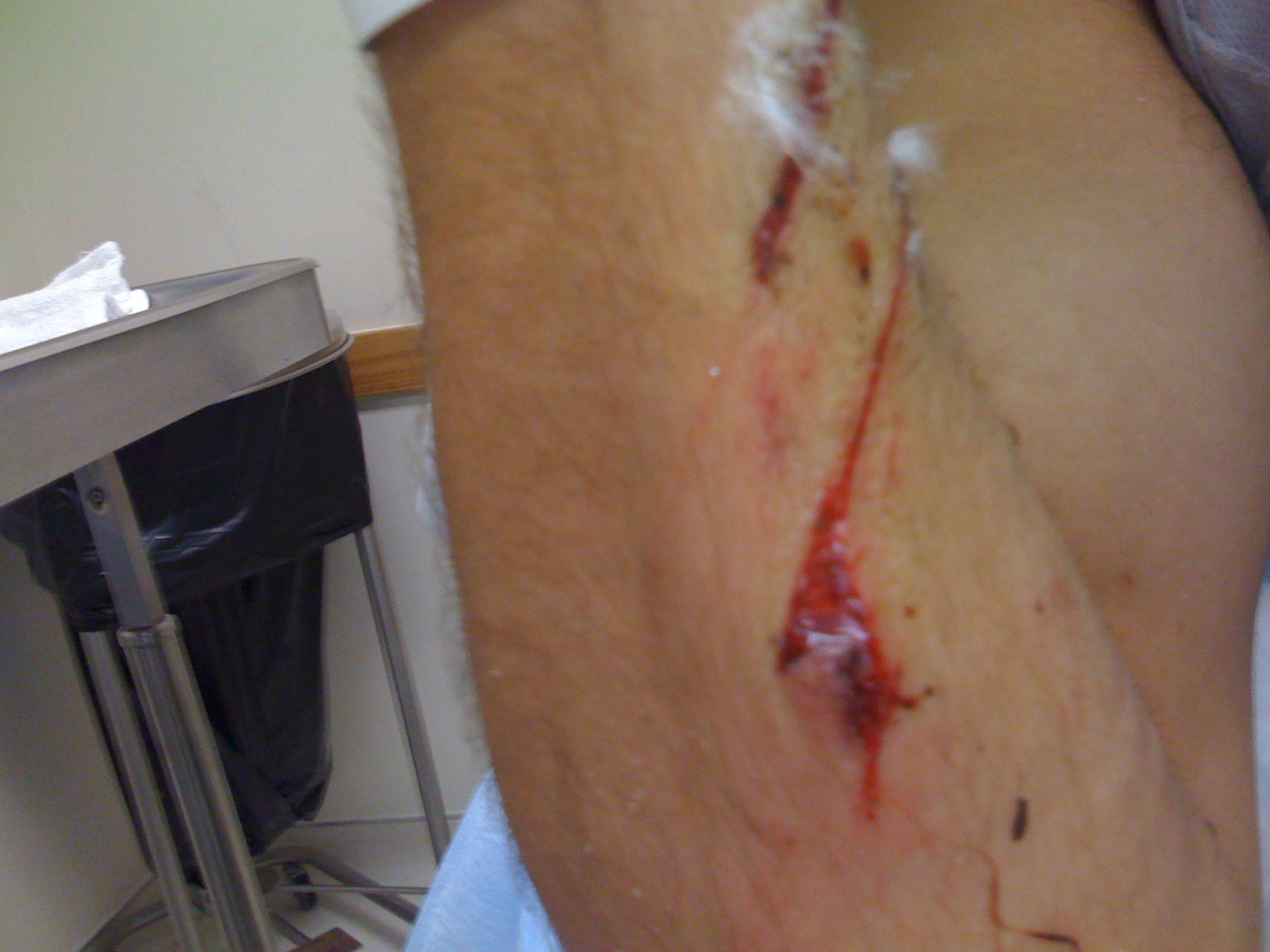
Maybe half-way into our run and a couple of miles from our cars, I took a breath and assessed the damage. Deep cut on left forearm, with at least one small stick protruding from the skin, one very scraped knee, assorted areas that would surely bruise, and a left hand pinkie at a distractingly unnatural position. No crying, no whining, but I was a bit concerned. It wasn’t like I was going to be airlifted off the hillside for some scrapes and a busted pinkie. So, I “zipped up my man-suit” and with Rob’s encouragement, we started running back towards our cars. We covered the couple of miles pretty quickly and without too much pain, and we were thoughtfully granted right-of-way when crossing of Highway 360 on foot – blood covered and a bit mangled.
It took some stitches and some “readjusting” of my finger to get me back on my way. I asked the ER doc if I could still finish out my run for the day, she couldn’t come up with a good reason not to, and I headed back home to get my final 5 or so miles. On the treadmill, since I’m no dummy.
My self-portraits from the emergency room fall short of gallery-quality but here are a few snapshots (mad at myself I didn’t get one of the pinkie which, as of June 2, 2011, looks only 37% unnatural):
Solid effort for my first ever 30K trail race. Was able to break 3 hours – 2:59:43 – for 30K trail race (which, as of June 2, 2011, I haven’t done again). Good for 47th out of 132. Winding, up and down, sometimes muddy course in Walnut Creek Park.
Finish line, just under 3 hours! Now go eat something.

From August 23-28, 2009, my running partner Rob Clark and I are competing in an event called the Trans-Rockies Run in the Colorado Rocky Mountains. It is a 6-day, 113 mile foot race that includes nearly 25,000 feet of elevation gain, reaching altitudes of over 12,500 feet. 97% of the race is run at above 8,000 feet. By comparison, Denver is known as the “Mile High City” due to its altitude of 5281 feet. So, to cover up to marathon distances every day for nearly a week, paired with the high altitude with some daily climbs up to 5,000 vertical feet, preparation is critical for finishing the race. And, while “just finishing” is certainly an accomplishment worthy of pride, Rob and I are training hard to compete with the 149 other 2-person teams. Many of these other competitors have decades of ultra-marathon experience and/or have the very real advantage of living and training at high altitude.
That’s some background about what we’re up against. For those who have asked or are now curious about what training entails, I figured I’d share some of the plan. In order to have the necessary peace of mind for myself and my family, I have had significant medical and fitness testing done. This testing included:
- An electrocardiogram (EKG), echocardiogram and a treadmill echocardiogram stress test conducted by a cardiologist. These tests checked the structural integrity of my heart and cardiovascular system and my physiological responses to aerobic stress
- A chest x-ray to get a view of my heart, lungs, and blood vessels to eliminate the possibility of issues not likely to be found through other testing
- Comprehensive blood labs to check cholesterol and a laundry list of chemical levels
- VO2 max and body composition testing led by toxicologist and competitive athlete Patricia Rosen
- And a grueling fitness evaluation by Bill Meyer, the Performance Director of CATZ-Austin.
The good news is that the 20+ years of working out have resulted in great overall fitness and good health. I’m quite far from being in elite athlete condition but it is clear from the various test results that I’m am benefiting from a healthy lifestyle. My heart (though slightly enlarged as a result of consistent endurance training) and lungs are strong. The numbers I’d want to be on the lower side are low, such as “bad” cholesterol, blood pressure, and resting heart rate.
The not-so-good news is that – surprise! – I am not physiologically gifted. In fact, it appears from the various testing that my body is somehow deficient in oxygen use. As it has been explained to me, my lungs are good at taking in oxygen and my heart is good at circulating the oxygenated blood. But, for reasons still not entirely clear, my muscles don’t do a great job in making use of the oxygen. So, I fatigue a bit easier than would otherwise be expected of someone with my level of training. Since my muscles tire a bit quicker, the result is a perceived need for more oxygen, which leads me to breathe a bit harder or faster but without the intended corresponding benefit. For the average guy or weekend warrior, this wouldn’t be an issue. But, this makes competitive running quite a challenge – I seem to have to work harder even for minimal performance gains. The lack of direct correlation between my high training intensity and performance gains wasn’t much of a surprise to me and, really, and I’m glad to have a better understanding of what’s going on. Basically, I just have to keep working a lot to get a little better.
Now, let’s talk about what training for an event like this entails. The goal is for me, a hard-working but otherwise average runner, to be high up in the mountains where the oxygen concentration is 40% lower and get me running up and down hills as fast as I can for 4-6 hours every day for a week. You can see why I’m inclined to train seriously for the task. Over the last decade I’ve averaged a couple of races a year, distances a short as a mile and others up to marathon distance (26.2 miles), some on roads, some on trails. I’ve worked out 5-7 days a week since I was 13, and for the last decade have included running distances that have ranged from 20-73 total miles a week. While in the mountains in northern New Mexico this winter (on February 15, 2009), I ran a solo marathon. On my 34th birthday (March 19, 2009), I ran a solo “ultra-marathon” of 34 miles. None of this has begun to prepare me for the rigors of the TRR.
Running, especially up and down hills for a week, takes more than cardiovascular endurance. The best trail runners do, of course, have remarkably strong hearts and lungs but they also need quite a bit of muscular strength, agility, balance, power, flexibility, and mental stamina to succeed. The team at CATZ Sports-Austin (Competitive Athlete Training Zone), under the direction of Bill Meyer, has stepped up to provide Rob and me with a sponsorship that includes world-class coaching. Training with Bill consists of non-stop conditioning sessions, roughly twice a week, along with performance benchmarking throughout the 5 month training for the TRR. His custom programs include all sorts of training that you can’t find elsewhere: heaving tractor tires, balancing on exercise balls while jugging sandbags, and circuit courses that mix stations of wheel-barrow crawling on dollies, throwing medicine balls, and running with 50lb bags. CATZ-Austin also has made available to us their team of trainers, nutritionists, and therapists to ensure we get more fit, stay healthy in the process, and finish the training and the race injury-free.
Our overall TRR training challenge is three-fold: (1) train for distance (15-25 miles day after day after day), (2) train for altitudes of 8,000-12,500ft, (3) train for steep ascents and descents (running up and down mountains, literally). And, I have (get!) to be able to do this while carrying a pack, on an unfamiliar course, while trying to stay within 2 minutes of my partner Rob for the entire event. Oh, and maybe I didn’t mention that Rob has the makings of an elite ultra-runner, with a running resume that includes high school cross-country team captain, a sub-16 minute 5k, and an “easy” recent first-time marathon of 3:20 (with no marathon training). My work is most certainly cut out for me.
- Distance training. There is no substitute for running a lot to get better at running a lot. So, starting April 20, 2009, Rob and I will start our structured program of running an average of about 56 miles a week, with peak weeks of 74, 79, 82, and 84 miles (each is more mileage than I’ve ever previously done). Though we’ll typically run 6 days a week, the heart of the schedule is the Monday-Tuesday back-to-back runs that will build to 30 miles on each day. Shorter runs of 6-10 miles will fill out the rest of the week with some days focused on speed or hills, others on recovery runs.
- Altitude training. Austin has a lot to love. No doubt about it. But, we seriously lack mountains. Since we’ll be doing most of our training at no higher than about 1000 feet, we have to compensate. One tool we’re each using is a Hyper Vest, generously provided by Hyper Wear founder, Cosmo Raines. The vest adds weight to make every workout a bit more challenging. It also can be cinched down tightly, creating mild, simulated hypoxic-like (low oxygen) training conditions. Additionally, roughly 5 weeks prior to the race we’ll again be working with Dr. Patricia Rosen, who will oversee our use of Intermittent Hypoxic Training with a Hypoxico Hypoxic Generator, a machine that gradually decreases breathable oxygen levels over the course of many hours of use. In effect, it helps give us a jumpstart on training our bodies to acclimate to the lower levels of oxygen we’ll experience in the Rockies. Roughly one week prior to the race we’ll head up to Colorado to get a week of natural altitude acclimatization, hopefully having given ourselves a good base prior to the start of the race.
- Hill training. Many of our runs will incorporate some ups and downs. That is just the nature of running on trails, or even on the streets in the Texas Hill Country. But, we’ve dedicated one run a week exclusively to hills. Some days that might mean hill repeats (up and down the same hill or hills, over and over). Other days we may just pick a particularly hilly route for a steady hard run. For those who don’t live in the mountains, a “hill” might seem like any grade where a manual transmission car would roll back a little. For trail runners – and more so for mountain trail runners – a “hill” is more likely to be an incline that most average folks wouldn’t consider walking up and running would be inconceivable. Some hilly sections that we’ll use for training will certainly involve something less than a runner’s pace; some may require us to pull ourselves or each other up by hand. The more of this we do in training, the better our chances of success at the race so it is entirely likely that some of the relatively short 6-mile hill days will be more physically taxing than 20-30 mile long runs.
A quick word on nutrition and rest – these are every bit as important as the more active components of training. I eat a lot and don’t hold myself out as being a monk. Sometimes pizza and beer is what I need. Sometimes a pint of ice cream. But, the basis of my diet is the stuff everyone knows they should eat but most don’t: whole grain (or sprouted multi-grain) cereals, pasta, and breads, unprocessed or lightly processed foods, brown rice, soy products, tons of fruit, veggies, nuts, seeds, yogurt, beans, cheese, eggs and sweet potatoes. Very little fried food (though French fries sneak in), anything with high-fructose corn syrup, hydrogenated oils, and limited butter or refined sugar. I concern myself more with getting the foods I need than avoiding the ones I don’t, so there’s no guilt if I eat some chocolate chip cookies with ice cream as long as I first had my black bean and avocado burrito with brown rice and steamed veggies.
As for sleep, I’m not like most distance runners. I think, at least for me, the more the better. 8.5-9 hours is a normal night, 9.5-10.5 is better and I try to get that much at least once or twice a week. One night recently I went to bed at 7:30pm, then awoke at 6:30am with plenty of energy to hang out with Sagan, catch up on work then head out for a hard 10-miler and be back home, showered, and ready for the day by 10am. But, if I cut back to even 7 or 8 hours of sleep I find myself without the necessary energy to be as productive the rest of the day as my schedule requires. Training is, of course, hard on the body and taking the needed time to recover is key. And I’m convinced there is no better way to recover than to sleep. A lot.
There may be other details to share as the training progresses. I regularly post updates through both Twitter and Facebook. If you have any questions, suggestions or comments, I’d love to hear them and will do my best to respond.
Last thing for now but perhaps the most important. I very much appreciate the support I continue to receive from family and friends. My ongoing ambitions – athletically and otherwise – would not have the same meaning in my life and would be far less likely to be realized if not for the love and interest from those I care about. Rob, Andres, and Richard, thank you for keeping me from dragging on all our runs. Alison, Jason, mom and dad, new friends and old, thank you for being part of this latest journey. Sagan, know that I do these things now in hopes that we can have a lifetime of active fun ahead, together.
The “Toughest Race in Texas” was one of my earliest trail running successes. By that, I mean I was able to push hard from start to finish, pass more people than passed me, and finish in a long, strong sprint. Writing this on June 2, 2011, I realize it wasn’t the longest race, hardest course, best field of competitors, or roughest conditions. But, it was very hilly on a technical course and getting 21st out of 139 runners was a real accomplishment. Though 51:12 may not sound fast for a 10K (my current 10K PR is 9 minutes faster), there’s really no comparing trail to road. Or, for that matter, one trail course to another.
That’s me in the grey. I had just passed the guy in white behind me and was able to pass one of the other two in the final stretch. The guy in the red beat me by 1 second, which isn’t so bad considering his road 10K was about 3 minutes faster than me at the time.
Went out for a leisurely trail run with my sorta-cousin, Adam Hirschkatz, who was in Austin for a family-ish reunion. Just minutes into the run I passed an old large Labrador-looking dog that was with its owner. It seems I startled the pooch and it snapped at my, latching onto my hip. The owner was as shocked as I was and very apologetic, the dog seemed scared (I had evidently startled it), and I just wanted to be on my way with the run. I checked for the dog’s vaccination tags, which it had, accepted the apologies, the stupidly continued with the run without so much as getting the owner’s phone number.
A couple miles later I realized the bite was more significant that first thought. After the run – yep, we finished the scheduled course in good time and good spirits – I returned home briefly enough to show off my wounds to our assembled out-of-town family members, then headed off to urgent care (what turned out to be the first of three emergency room visits resulting from running adventures in the span of a few months).
I was rightfully scolded by just about everyone for not getting the owner’s info, reporting the incident, etc but survived without an issues, other than the distinctive scarring across my ass.
Here’s the damage, when fresh:


10K – 49:34 – 932/6567
Rainy and rough, with a little bit of typically problematic “self-seeding”:


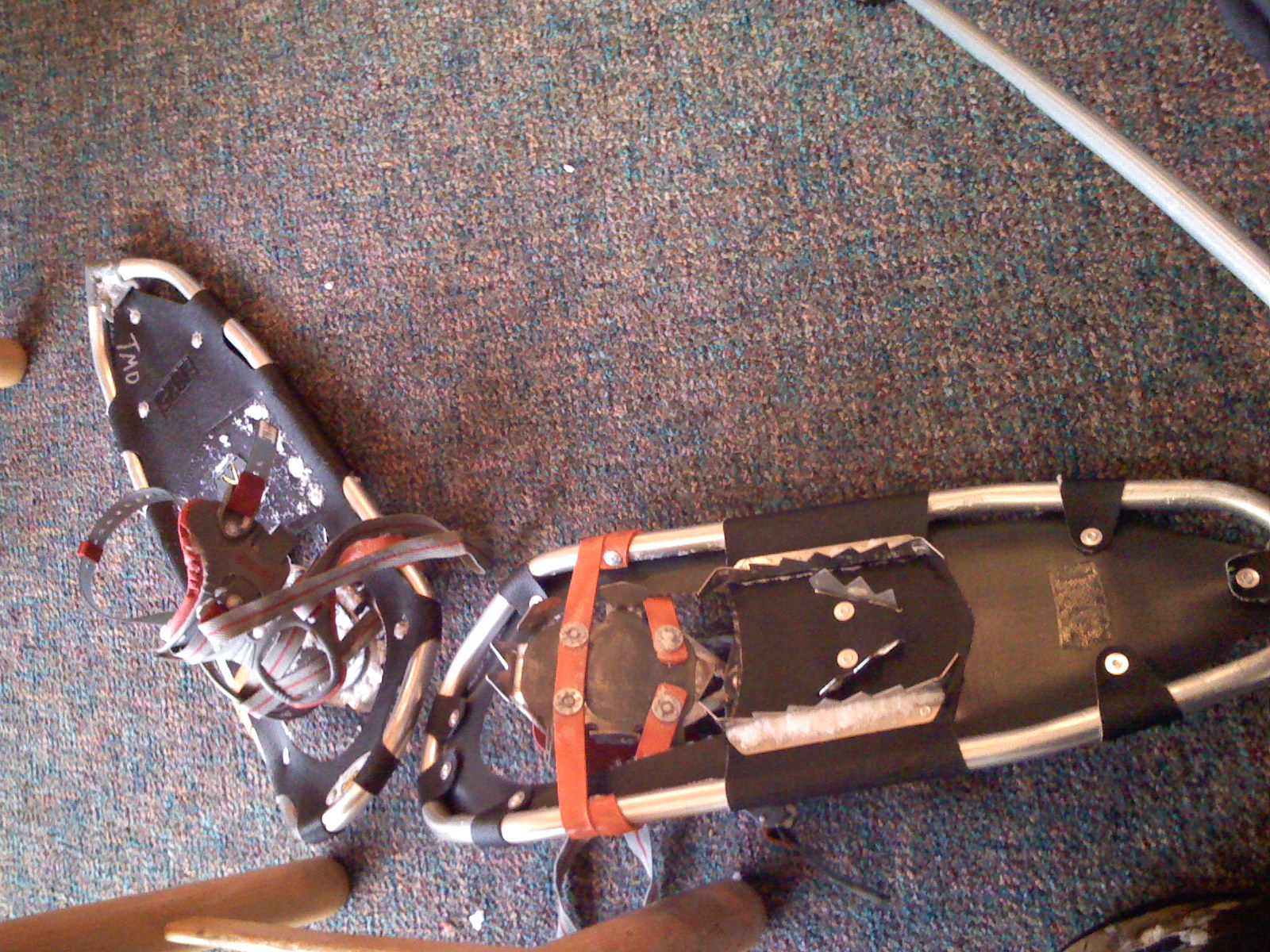
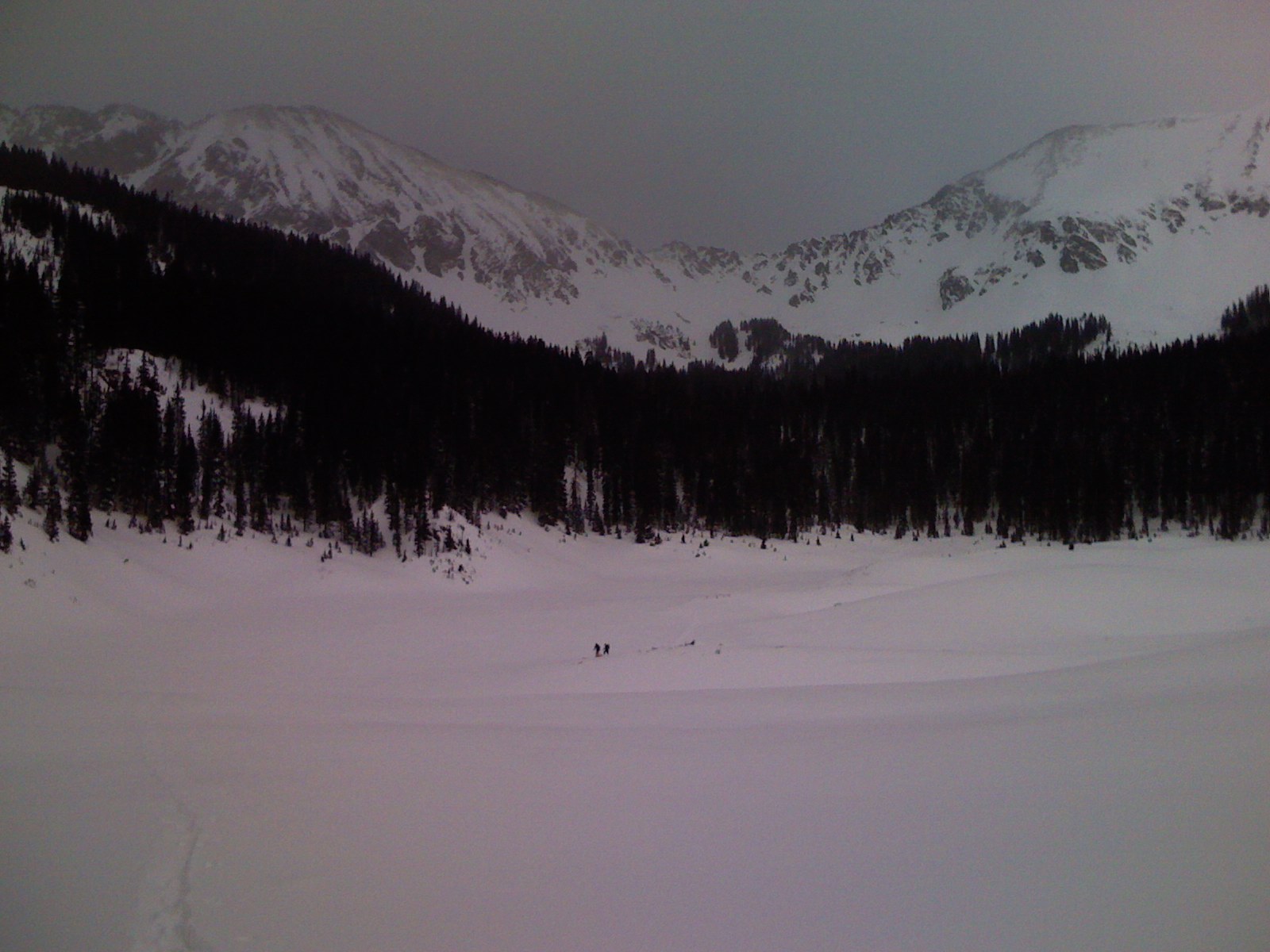
On my first trip to Taos, lured to the southern Rockies by William Brokhof, I had my first chance to try shoe shoeing. For those who haven’t tried it but, think the beauty of hiking with the exercise of trail running, with just a bit of excitement that comes from being stranded miles from anywhere in hip-deep snow.
See the excitement?
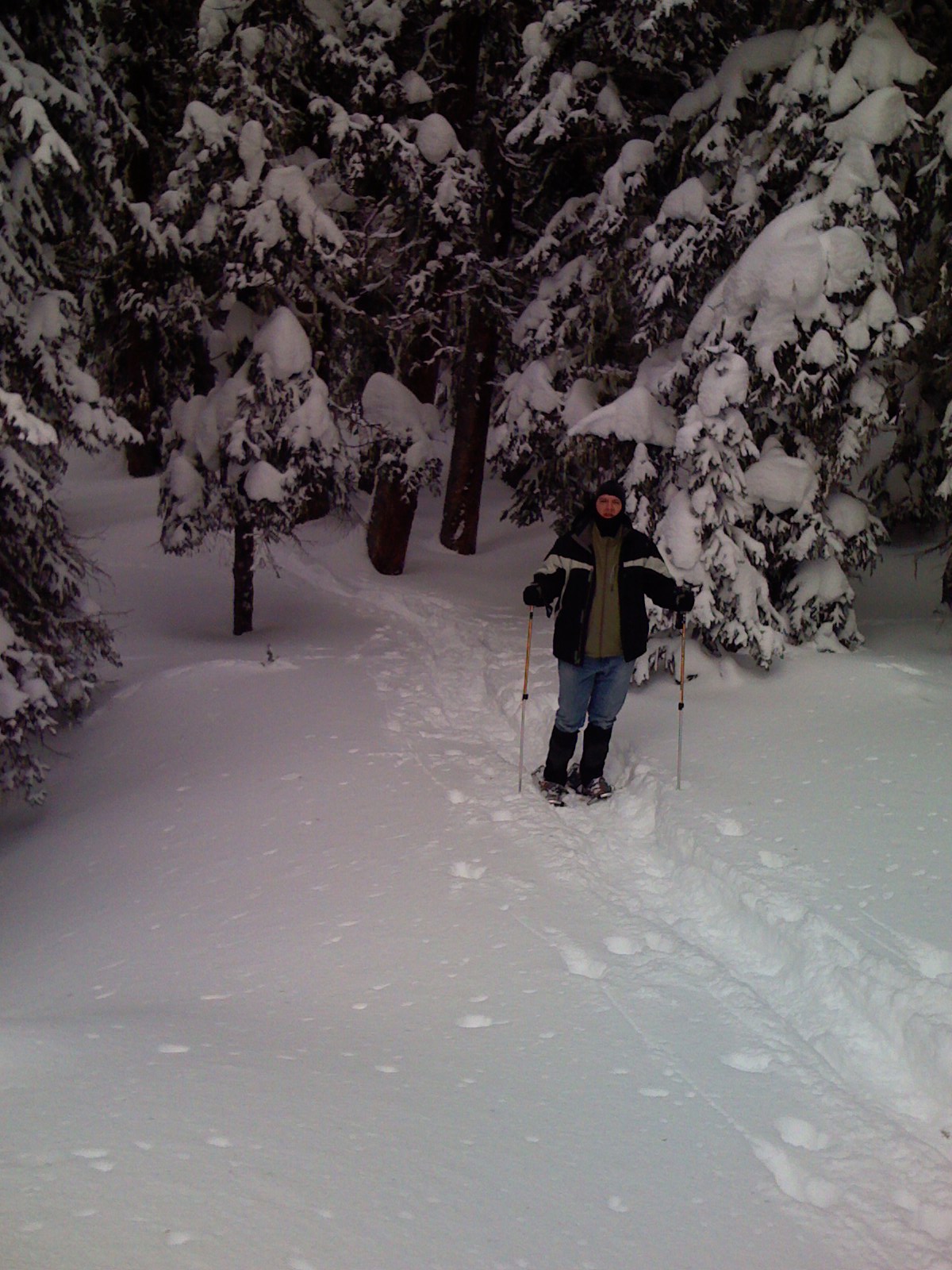
The first time for something like this often one of the most memorable. William and I headed out on one of the more popular routes that leads from The Bavarian restaurant in the Taos Ski Valley up to William’s Lake (yeah, how about that?). Continuing on from the lake one could theoretically go on to summit Wheeler Peak (13,161 ft), which is visible from the logical turn-around point, but doing so is challenging in the summer and pretty dumb to even try in winter. My half-hearted attempt to do so in the winter of 2011 found me moving at roughly a mile-per-hour on a 45 degree slope in loose, thigh-deep snow. It is a challenge I’ll have to take on at some point, but not solo (as I was) and such a round-trip effort would mean starting in early morning to ensure it doesn’t become a one-way trip.
The entire round-trip is something short of 4 miles but can easily take 2 hours. And, despite its reputation as “one of the most popular routes”, in the 4 times I’ve done it I’ve seen a total of about 10 people. “Popular” is relative when talking about lung-busting, avalanche-prone hikes in the middle of winter at over 11,000 ft.
The only other people we saw:
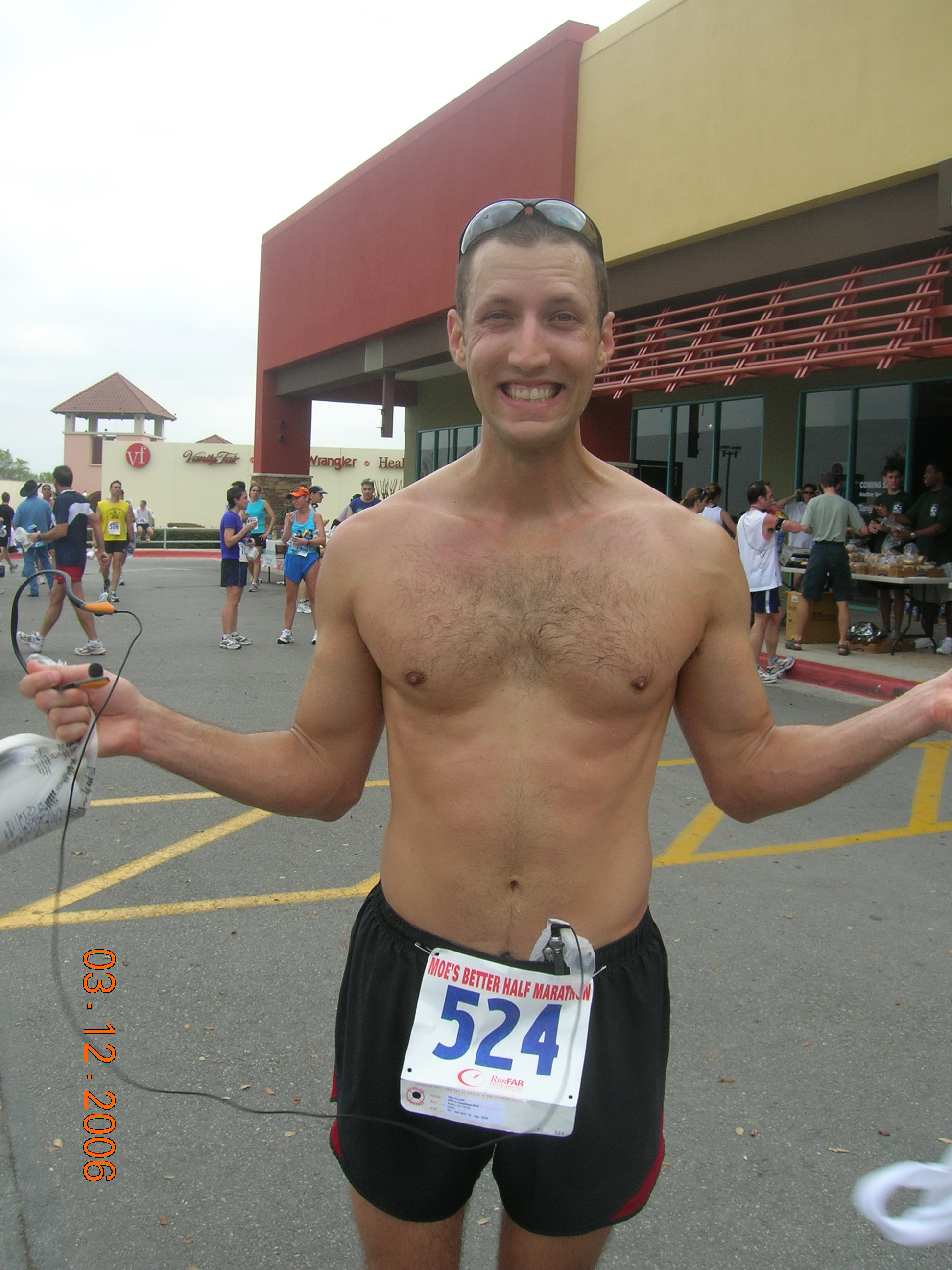
Here’s me early in my running/racing “career”. This one out in San Marcos was hilly and warm and, at the time, I was really happy with my 2:01:44.
This was after I had shed all those pounds of pesky muscle but before I learned that it is ok to run faster, even if it hurts.
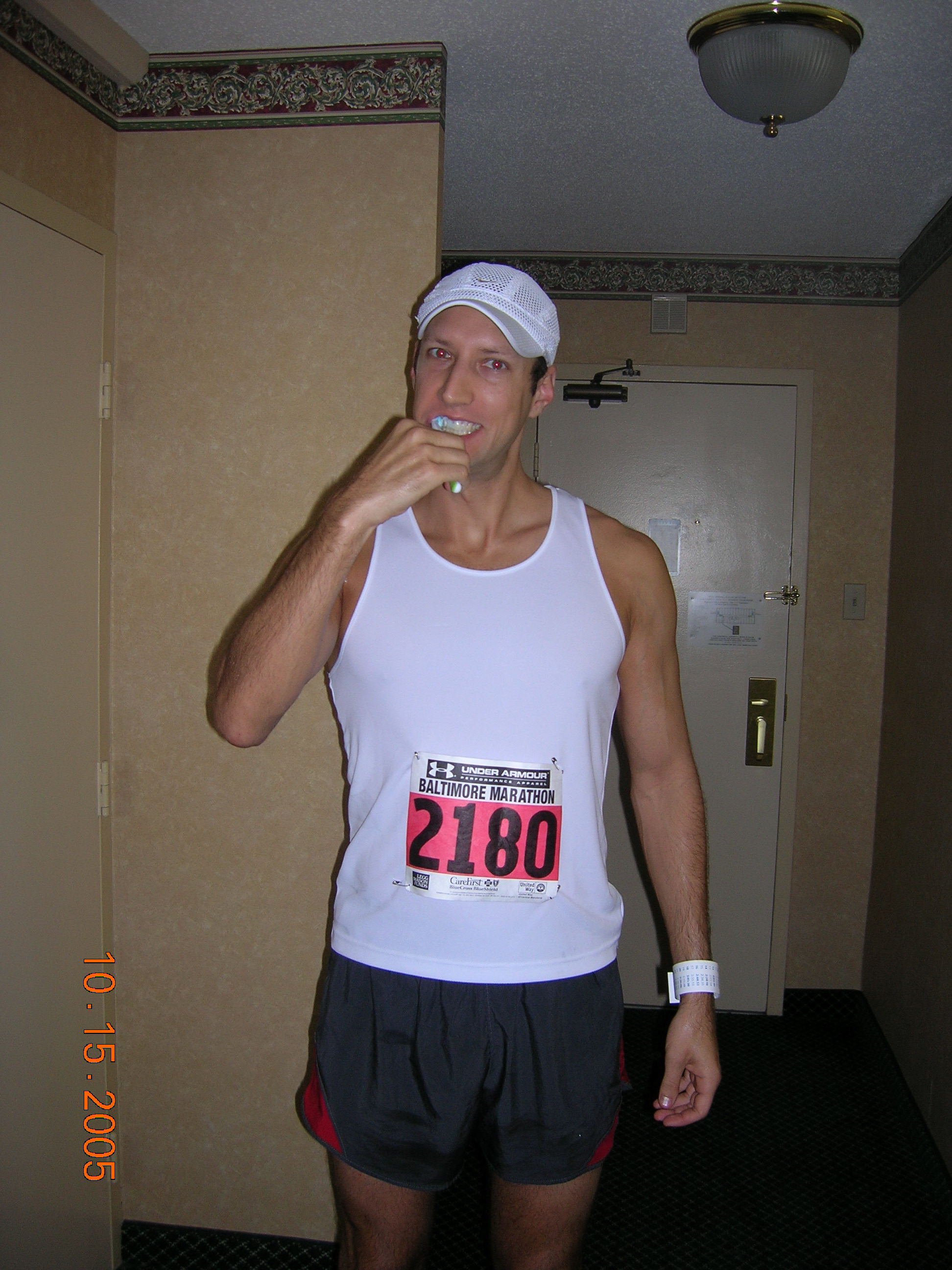
I went into this marathon, my second overall but longest run in 4 years, with a decent training cycle. I wanted to improve upon my Chicago 2001 time of 3:59. Through the first 10 miles I was confident. By halfway I was certain, having run about 1:50-something and still feeling quite good. Then, just minutes later, crash. I entered a long hilly section (in retrospect, probably only about 3 miles and not that steep) and it destroyed me. I ended up having to walk multiple times for many minutes at a stretch, something that I hadn’t done before or since (as of June 3, 2011) on any road race. I ended up running 4:42:44, which isn’t a horrible time unless your goal is 3:50. So, that second half took me about 2:45, which just shouldn’t happen…unless you train improperly for the course and go in cocky.
Still always good to finish a marathon, which I did at a full sprint, as I always try to. Blissfully ignorant as to what the rest of the morning had in store, I was happy to be almost at the start line (with fresh breath)…
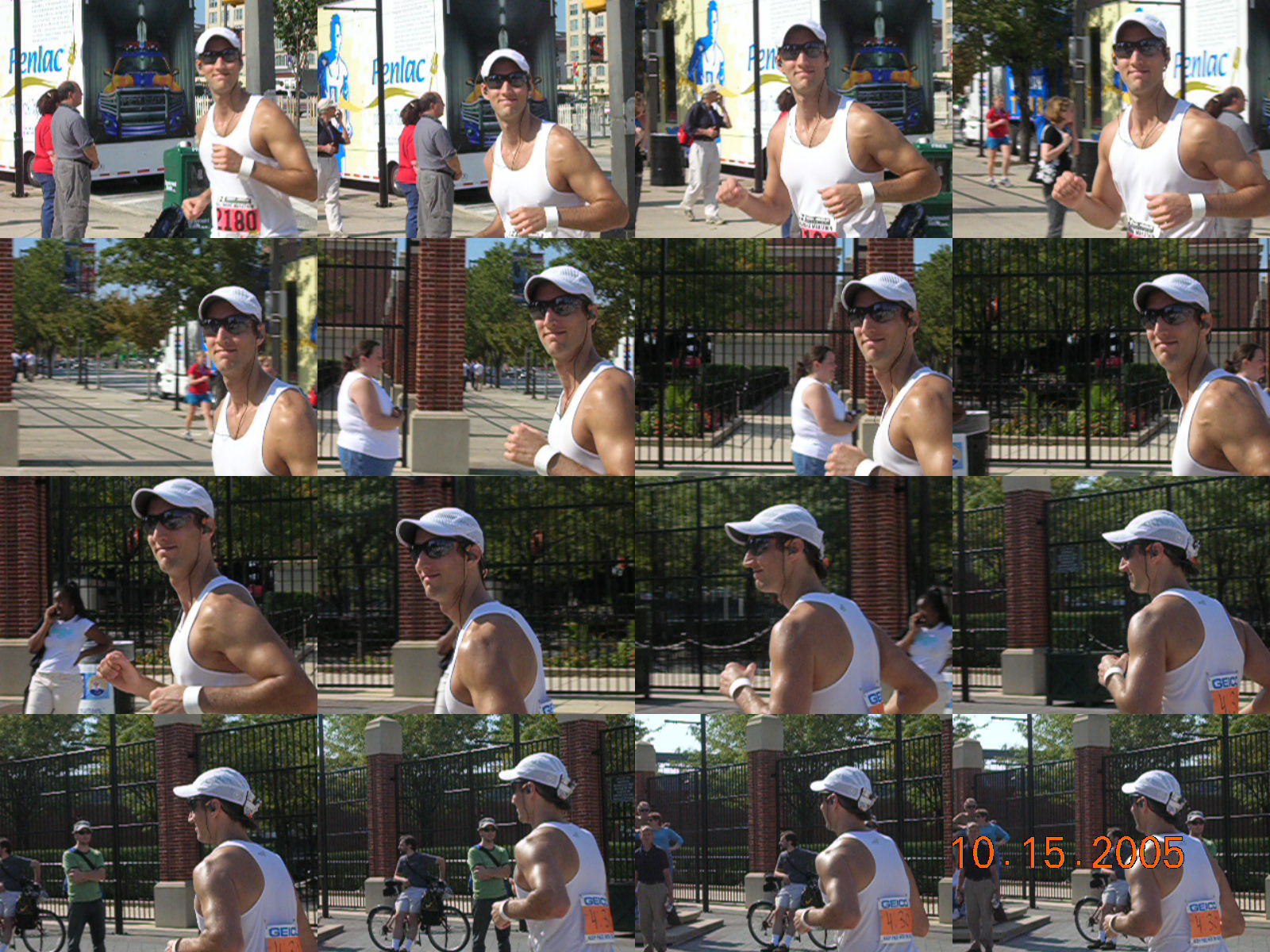
And Alison was good at catching me at a point that I imagine must have been in the first half…

 Kind of Like Fun